Bluetooth Channel Sounding: How Bluetooth 6 Changes Lost-Item Finding and Digital Keys
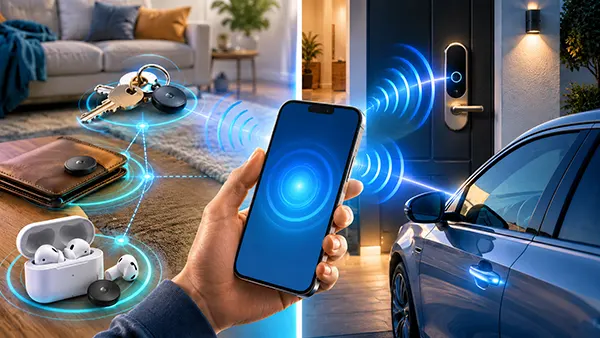
Bluetooth has been able to tell devices that something is nearby for many years, but estimating exactly how far away it is has been much harder. Bluetooth 6 changes that situation through Channel Sounding, a distance-measurement feature introduced with Bluetooth Core 6.0 and improved in later releases. Instead of relying mainly on signal strength, compatible devices can measure distance using characteristics of the radio signal itself. The change has direct implications for item trackers, smart locks, access systems and phone-based digital keys. By 2026, the technology has moved beyond specification documents: Android includes system support for Bluetooth Channel Sounding, Apple has announced support for compatible iPhones and accessories, and Bluetooth Core 6.3 adds further ranging improvements. The important point for ordinary users is simple: Bluetooth is becoming capable of knowing not only that another device is close, but approximately how far away it really is.
Why Bluetooth 6 Can Measure Distance More Reliably
Older Bluetooth finding systems often estimate proximity through Received Signal Strength Indicator, usually shortened to RSSI. The principle is straightforward: a strong signal generally suggests that two devices are close, while a weaker signal may indicate that they are farther apart. The problem is that walls, furniture, the human body, device orientation and radio interference can all change signal strength. A tracker sitting two metres away inside a bag may therefore appear farther away than an unobstructed device at the same distance. RSSI remains useful for broad categories such as near, medium and far, but it was never designed to provide consistently precise distance measurements. Bluetooth SIG documentation notes that traditional RSSI-based ranging has commonly been limited to accuracy worse than one metre. Channel Sounding addresses this limitation by measuring properties that are more closely related to the actual travel of the radio signal.
The main method is Phase-Based Ranging, or PBR. Two connected Bluetooth Low Energy devices exchange signals across several frequencies within the Bluetooth radio band. The system examines how the phase of those signals changes during the exchange and uses the measurements to estimate distance. Users do not need to understand the underlying calculations to benefit from them. In practical terms, the phone and accessory can obtain a much more meaningful answer to the question “how far apart are we?” than they can from signal strength alone. Bluetooth SIG describes Channel Sounding as capable of centimetre-level ranging under suitable conditions. Real-world accuracy will still depend on hardware design, antennas, surroundings, software filtering and the ranging algorithm used by the manufacturer, so centimetre-level capability should not be interpreted as a guarantee that every consumer device will always report distance to the nearest centimetre.
Bluetooth 6 also addresses the fact that distance can have security consequences. Channel Sounding includes Round-Trip Timing, or RTT, alongside phase-based measurements. RTT measures the time required for protected packets to travel from one device to another and back again. Its main role is not simply to provide another number on a screen. It can be used as an independent check against attempts to manipulate the apparent distance between devices, including sophisticated relay attacks in which an attacker tries to make a legitimate phone appear closer to a lock than it really is. This matters little when locating headphones under a sofa, but it becomes important when Bluetooth is involved in unlocking a door, opening a vehicle or authorising another proximity-based action. Bluetooth 6 therefore treats accurate ranging and secure ranging as related problems rather than completely separate features.
What Channel Sounding Actually Changes for Users
The most noticeable difference is the transition from vague proximity to measured distance. A conventional Bluetooth application might show that a tracker is “nearby” or indicate signal strength through a series of bars. With Channel Sounding, a compatible application can instead work with an estimated physical distance. Someone searching for keys can see that the tag is five metres away, move through the room and watch the figure fall towards one metre. That is especially useful in places where sound alerts are difficult to hear or where several similar accessories are nearby. Distance can also be used automatically. A lock, for example, could remain closed while an authorised phone is several metres away and only consider an unlocking request after the measured distance falls below a defined threshold.
Channel Sounding should not be confused with automatic direction finding. Distance tells an application how far away the other device is, but by itself it does not necessarily tell the user whether the object is to the left, right, above or behind them. A manufacturer can combine ranging with other Bluetooth positioning methods, device sensors or additional radio technologies when directional guidance is required. Even without a direction arrow, however, reliable distance is useful: a person can move a few steps and immediately see whether the number is falling or increasing. Bluetooth SIG specifically allows Channel Sounding to work alongside RSSI and Bluetooth Direction Finding. A product can therefore use low-cost proximity checks at longer distances and switch to finer Channel Sounding measurements when the devices get closer.
There is another practical qualification: Bluetooth defines how the ranging procedure works, but it does not prescribe one universal distance-calculation algorithm for every product. Manufacturers can choose algorithms suited to their hardware and use case. This leaves room for differences between a small tracker, a phone, a vehicle and an industrial sensor. The Bluetooth Ranging Profile, adopted in late 2024, provides a standard way for applications to configure ranging and obtain results from another device, which helps interoperability, but identical radio support does not mean every product will produce identical measurements. By 2026, this distinction is increasingly relevant because Channel Sounding is moving into commercial operating systems and components. Buyers will need to look for explicit Channel Sounding support rather than assuming that any device labelled Bluetooth 6 automatically provides the same ranging experience.
Finding Lost Items with Real Distance Awareness
Item finding is one of the clearest consumer uses for Channel Sounding. Bluetooth trackers already help people locate keys, wallets, luggage and bags, but the final few metres can be frustrating. A network may indicate that an item is somewhere inside a house, office or café, while conventional Bluetooth proximity can narrow the search only approximately. Channel Sounding improves the local part of that process. Once the phone connects to a compatible tracker, it can measure the distance between the two devices more accurately and update that measurement as the user moves. A search can therefore change from checking every room because the tag appears “close” to following a decreasing distance value. The same principle can be built directly into headphones, cameras, tools, remotes and other Bluetooth accessories instead of requiring a separate tag attached to every object.
Indoor environments are particularly relevant because they expose the weaknesses of simple signal-strength ranging. Radio signals can reflect from walls, floors, metal surfaces and furniture. A person holding a phone can also obstruct part of the signal path. Phase-based ranging across multiple frequencies provides more information than one RSSI reading and is designed to cope better with these conditions. It is not immune to difficult environments, and measurements can still fluctuate, particularly where the direct radio path is heavily obstructed. Software normally has to filter unstable results rather than display every raw measurement. For users, the advantage is therefore not perfect indoor positioning but a much more useful estimate of distance than traditional proximity alone. That difference can be enough to tell whether luggage is beside a hotel-room door, several metres down a corridor or still inside another room.
Channel Sounding can also broaden the range of products that provide precise local finding. Ultra-wideband already offers highly accurate ranging and is used in several premium phones and trackers, but it requires dedicated UWB hardware in both devices. Bluetooth Channel Sounding works through suitably designed Bluetooth Low Energy radios, allowing manufacturers to add fine ranging without necessarily fitting another radio solely for that purpose. That can be particularly relevant to small accessories where cost, circuit-board space and battery consumption matter. It does not mean Channel Sounding makes UWB obsolete. UWB remains valuable for precise spatial positioning and secure ranging, and manufacturers may continue to combine technologies. Bluetooth 6 instead makes better distance awareness available to a much wider class of Bluetooth products for which a separate UWB implementation may not be practical.
What a 2026 Bluetooth Finding Experience Looks Like
Android provides one concrete sign that Channel Sounding is becoming a consumer feature rather than a laboratory concept. Android 16 introduced a Ranging module that can work with Bluetooth Channel Sounding, Bluetooth RSSI ranging, UWB and Wi-Fi ranging technologies through a common set of application interfaces. Hardware support is still required; installing a newer Android version cannot add Channel Sounding to a phone whose radio does not support it. Android’s compatibility requirements also provide a useful reality check for marketing claims. A device that declares the Bluetooth Low Energy Channel Sounding hardware feature must meet a ranging accuracy requirement of within plus or minus 0.5 metres at the 90th percentile when tested at a distance of one metre. That requirement is less dramatic than ideal centimetre-level laboratory results, but it establishes a measurable baseline for compatible Android hardware.
Apple has also moved towards Bluetooth Channel Sounding. At WWDC 2026, Apple presented new Core Bluetooth and Nearby Interaction support that allows applications to measure distance to compatible third-party Bluetooth accessories. Apple’s developer guidance states that the feature is supported on iPhones equipped with the N1 chip and is intended for use with iOS 27. Apple also requires compatible accessories for this implementation to support Bluetooth 6.3 and its Inline Phase Correction Term capability. This is significant because it shows how quickly the Bluetooth specification continues to evolve: Channel Sounding arrived in Core 6.0, while products introduced only a couple of years later can already make use of refinements from Core 6.3. It also means accessory compatibility has to be checked carefully rather than judged from the Bluetooth version number alone.
For users in 2026, the transition will therefore be gradual. Existing Bluetooth trackers will not gain precise Channel Sounding measurements simply through an application update if their radio hardware lacks the required capability. A new phone with Channel Sounding also needs a compatible device at the other end of the connection. During the transition period, finding applications can continue to combine network-assisted location, RSSI proximity, sound alerts, UWB and Channel Sounding according to the available hardware. This mixed approach is likely to be more useful than treating one technology as a universal replacement for all others. Network finding remains important when an item is kilometres away, while Channel Sounding is most valuable after the owner is physically near the object and needs to reduce the search area from a room or corridor to a much smaller distance.
Digital Keys Become More Precise About When to Unlock
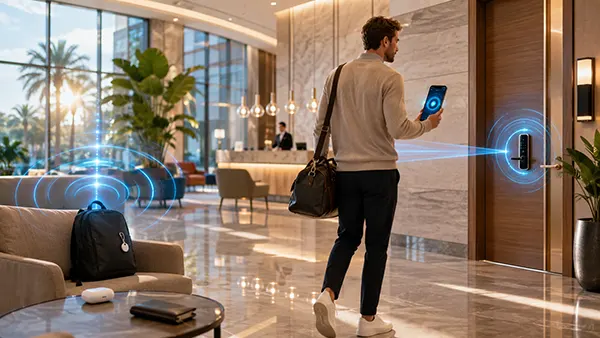
Digital keys have a different requirement from lost-item trackers. Finding software mainly needs to help a person move closer to an object; an access system must decide whether proximity is sufficient to permit a security-sensitive action. Cars, building doors, gates, lockers, safes and bicycles can all use Bluetooth as part of keyless access. Signal strength alone can make such decisions difficult because a strong or weak signal does not map consistently to a physical distance. Channel Sounding allows a system to base part of its decision on measured range. A car could recognise an authorised phone while its owner approaches but wait until the phone is genuinely close to the vehicle before enabling passive entry. A smart lock could apply a similar rule at a doorway, reducing situations in which a device located farther inside or outside a building is treated as being immediately next to the lock.
Accurate distance also addresses a long-standing security concern with passive keyless systems: relay attacks. In a relay scenario, an attacker forwards communication between a legitimate key or phone and the lock, attempting to make two distant devices behave as if they were close together. Bluetooth Channel Sounding includes security mechanisms designed to make manipulation of the measured range more difficult. Phase-Based Ranging can be combined with secure Round-Trip Timing so the system has an independent way to verify whether the reported distance is plausible. Bluetooth Core 6.2 added further amplitude-based attack resilience for Channel Sounding. These measures do not make every Bluetooth lock automatically secure; implementation quality, credential protection, authentication and the wider access-control design still matter. They do, however, give manufacturers stronger standardised tools for checking physical proximity.
Bluetooth Channel Sounding should also be considered in the context of existing digital-key systems rather than presented as an immediate replacement for UWB or NFC. The Car Connectivity Consortium’s Digital Key work continues to use complementary technologies. Bluetooth Low Energy can support communication and authentication, UWB can provide secure location-aware ranging, and NFC remains useful for close-range access and fallback scenarios. The CCC expanded its certification coverage for Bluetooth LE and UWB in 2025, and its 2026 certified-product listings include automotive Bluetooth modules qualified against Bluetooth Core 6.0. Channel Sounding gives vehicle and device manufacturers another option for distance-aware Bluetooth designs, particularly where reducing radio complexity is valuable. The exact technology used to authorise a particular car remains a decision for the vehicle manufacturer and the relevant digital-key specification rather than a capability that Bluetooth 6 imposes by itself.
Bluetooth 6.2 and 6.3 Make Ranging More Practical
The original Channel Sounding feature arrived with Bluetooth Core 6.0, adopted in August 2024, but development did not stop there. Bluetooth Core 6.2, adopted in November 2025, introduced Channel Sounding Amplitude-based Attack Resilience. At a high level, this gives implementations additional information for detecting suspicious conditions that could indicate an attempt to manipulate ranging signals. The improvement is especially relevant to applications in which measured distance influences access decisions. Consumers are unlikely to see a setting labelled with the technical feature name, but refinements of this kind matter behind the scenes. A digital key is useful only if the system can distinguish an authorised device that is genuinely beside the lock from communication that has been altered or relayed from somewhere else.
Bluetooth Core 6.3, adopted on 5 May 2026, added two further Channel Sounding improvements. Inline PCT Transfer is designed to reduce unnecessary processing and data transfer during phase-based ranging while improving efficiency and accuracy. The same release introduced PHY-specific RTT accuracy reporting, which allows devices to describe timing accuracy more precisely for different Bluetooth radio modes. These are implementation-level changes rather than new features that users have to configure. Their importance is that Channel Sounding is being refined as manufacturers begin to integrate it into phones, accessories, locks and other products. Apple’s 2026 accessory requirements provide a practical example: its announced Channel Sounding implementation specifically requires Bluetooth 6.3 Inline PCT support on compatible accessories.
The result is a gradual change in what the Bluetooth logo can mean for location-aware products. Bluetooth is still a communications technology, but compatible Bluetooth 6 hardware can now provide a far stronger understanding of physical distance than earlier signal-strength methods. Lost-item finding can become more informative during the final metres of a search, while digital keys can make proximity decisions using measured range rather than an unreliable signal-strength threshold alone. Adoption will depend on new radios at both ends of the connection, suitable antennas, good software and manufacturers choosing to enable the feature. As of 2026, Channel Sounding is therefore best understood as an emerging practical capability rather than something already present in every Bluetooth 6 product. Its significance lies in making accurate, security-aware ranging part of mainstream Bluetooth hardware instead of requiring a separate positioning technology for every use case.